
The architecture industry sits at the intersection of design, engineering, and economic development, shaping the spaces where people live, work, and interact. From residential communities and commercial hubs to large-scale infrastructure and public projects, it plays a foundational role in how modern environments are built and continuously transformed.
As global cities expand and construction demands evolve, the industry is increasingly influenced by factors such as urbanization, sustainability requirements, technological advancement, and large-scale public investment. These forces are reshaping how architectural services are delivered and how the profession contributes to broader economic and societal development.
This article explores key architecture industry statistics and data points that define the industry today, offering a clear, numbers-driven view of its scale, structure, and future direction.
Architecture Industry Statistics in the United States Workforce
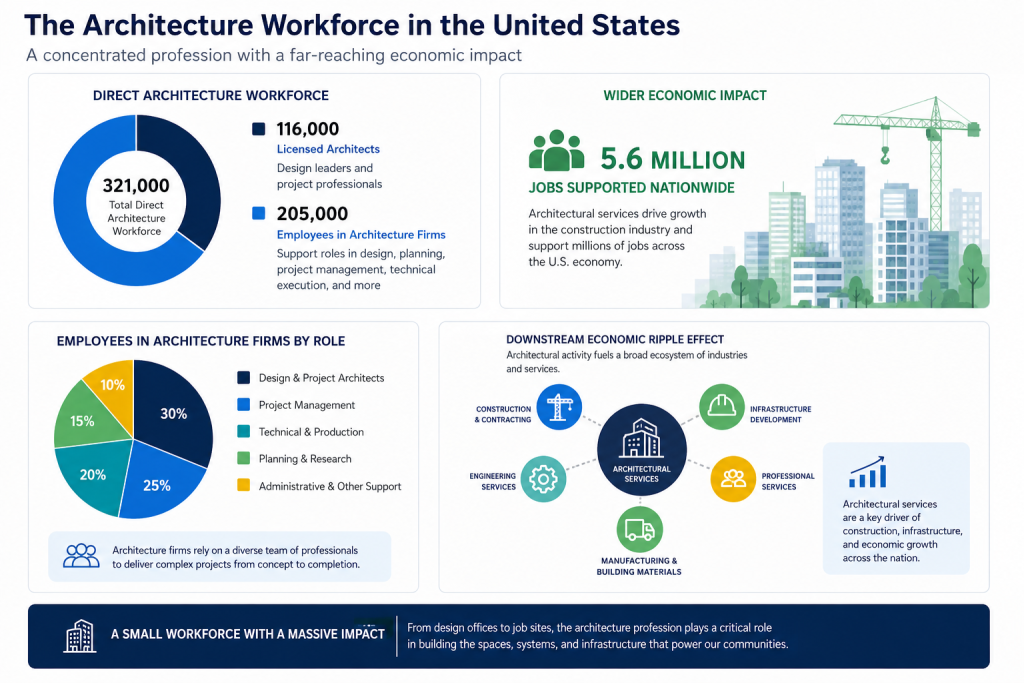
The U.S. architecture workforce is relatively concentrated but highly influential. According to architecture industry statistics, there are 116,000 licensed architects operating in the country. These professionals work alongside a broader base of around 205,000 employees in architecture firms, covering roles that support design, planning, project management, and technical execution.
Beyond direct employment, the industry has a much wider economic reach. Architectural services drive growth toward the construction industry and support around 5.6 million jobs nationwide, demonstrating that its influence extends far beyond design offices into construction, infrastructure, and related sectors.
The scale of employment becomes even more significant when considering downstream effects, as architectural activity is deeply connected to construction, engineering, and infrastructure development across the economy.
Employment growth in the sector is also expected to continue, especially as firms increasingly rely on structured marketing systems and services that generate consistent project leads for architects. Architectural employment is projected to increase by 8% through 2033, which is faster than the national average for many occupations. This indicates sustained demand for design expertise as construction activity, infrastructure investment, and urban expansion continue.
Architecture Industry Statistics Revenue and Market Size
The U.S. architectural services market has demonstrated consistent growth over recent years, with both revenue expansion and long-term forecasts pointing toward a stable upward trajectory driven by construction activity, infrastructure investment, and sustained demand across multiple sectors.
Market Size and Revenue Expansion
The market size was valued at $73.01 billion in 2023, increasing to $75.87 billion in 2024. Forecasts indicate continued expansion to $97.09 billion by 2030, reflecting steady demand across residential, commercial, and public infrastructure projects.
Longer-term projections suggest even greater growth, with the industry expected to reach approximately $158 billion by 2034, supported by a projected 4.5% CAGR.
Earlier industry performance also shows strong momentum, with revenue growing at a 1.5% CAGR over the past five years, highlighting a consistent expansion trend over time.
Growth Rates and Industry Outlook
Across multiple datasets, the architecture industry statistics shows moderate but stable growth patterns. From 2024 to 2030, the U.S. architectural services market is projected to grow at a 4.2% CAGR, while long-term forecasts indicate a similar trajectory of around 4.5% through 2034.
This steady growth pattern reflects the nature of the industry, which is closely tied to long-term infrastructure development and construction cycles rather than short-term volatility.
Employment and Financial Indicators
Employment trends further reinforce this outlook. Jobs in the profession are expected to increase by 4% between 2024 and 2034, aligning closely with average occupational growth rates. In addition, employment is projected to grow by 8% through 2033, indicating continued demand for architectural expertise.
On the financial side, gross billings at U.S. architecture firms have increased significantly over time, rising from $44 billion in 2008 to $104.1 billion in 2023, representing a 136% increase over 15 years. This underscores the expanding financial scale of the profession alongside broader industry growth.
Economic Impact of Architecture on the U.S. Economy
Beyond market size and employment, architecture has a major multiplier effect on the broader economy. The profession enables approximately $693 billion in construction value, linking design services directly to physical infrastructure development across residential, commercial, and public sectors.
Its influence extends further through economic ripple effects. Architecture generates a 1.5× GDP multiplier, meaning that every dollar invested in the profession contributes an additional $1.50 to the wider economy. This highlights how architectural services function as an economic catalyst rather than an isolated industry.
When combined with construction, engineering, and associated services, architecture supports millions of jobs and contributes significantly to national economic output, reinforcing its role as a foundational sector in the U.S. economy.
Key Industry Segments and End-Use Breakdown
The architecture industry is not uniform; it is divided into multiple service types and end-use sectors with varying levels of demand.
In terms of service structure, construction and project management services account for the largest share at 32.3% of revenue (2023). This reflects the increasing complexity of modern building projects, which require integrated planning, scheduling, and resource coordination.
On the end-use side, the industrial sector represents the largest share at 43.2% of revenue (2023). Industrial expansion, including factories and large-scale facilities, continues to drive significant architectural demand.
Some segments are also growing faster than others. Legal compliance consulting is projected to grow at a CAGR of 6.2% from 2024 to 2030, reflecting increasing regulatory complexity in construction. Meanwhile, the education sector is expected to grow at 6.1% CAGR, driven by demand for modernized learning environments.
Fastest-Growing Sectors in Architecture
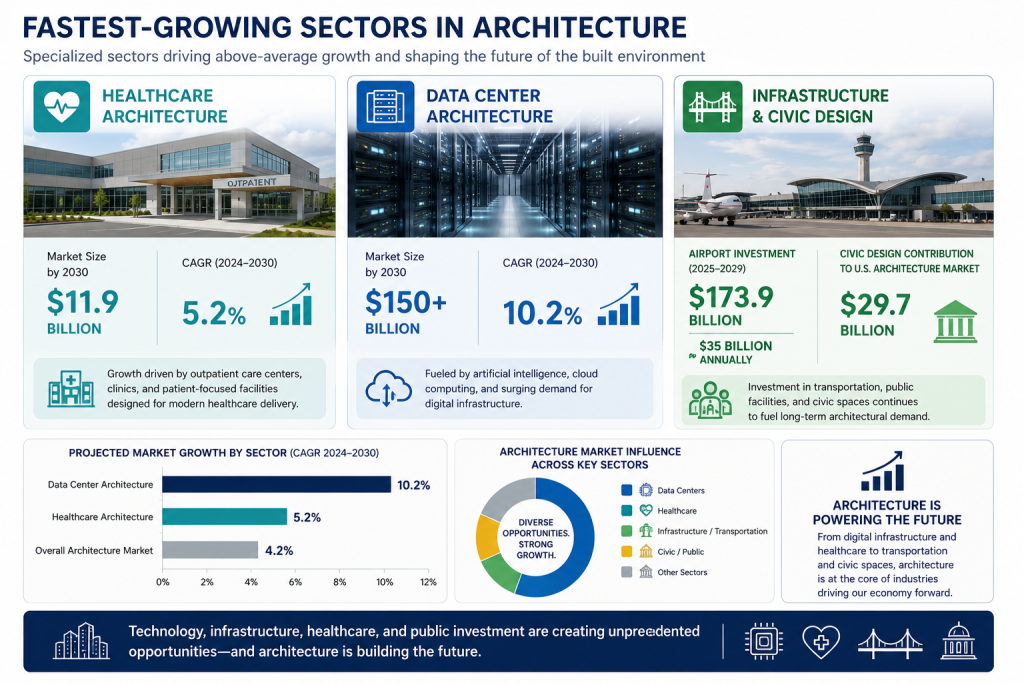
Several specialized sectors are driving above-average growth within the architecture industry. Healthcare architecture is a key growth area, with the U.S. healthcare architecture market expected to reach $11.9 billion by 2030, growing at a CAGR of 5.2%. This expansion is driven by the development of outpatient care centers, clinics, and patient-focused facilities.
Data center architecture is another rapidly expanding segment. The U.S. data center construction market is projected to exceed $150 billion by 2030, growing at a CAGR of 10.2%, largely fueled by artificial intelligence, cloud computing, and digital infrastructure demand.
Infrastructure investment is also a major driver. Airports alone are expected to require $173.9 billion in investment between 2025 and 2029, averaging around $35 billion annually. At the same time, civic design contributes approximately $29.7 billion to the broader U.S. architecture market.
These figures highlight how architecture is increasingly tied to technology, transportation, healthcare, and public infrastructure development.
Key Industry Drivers and Market Forces
Several structural forces are shaping the long-term trajectory of the architecture industry statistics, influencing both demand and the types of projects being developed across the United States.
| Driver | Description | Industry Impact |
| Public Investment | $1.2 trillion Infrastructure Investment and Jobs Act supporting roads, bridges, water systems, and broadband | Expands civic and infrastructure-related architectural projects |
| Urbanization & Population Growth | Rising population density and continued expansion of metropolitan and developing regions | Increases demand for residential, commercial, and mixed-use developments |
| Sustainability Initiatives | Government and industry push for green buildings and environmentally responsible construction | Accelerates adoption of energy-efficient and sustainable design practices |
| Digital Transformation | Increased use of CAD and advanced design technologies in architectural workflows | Improves efficiency, precision, and project delivery speed |
These combined forces continue to reinforce steady demand for architectural services across both public and private sector projects, while also reshaping how modern buildings and infrastructure are designed and delivered.
Conclusion
The architecture industry continues to evolve alongside economic growth, technological innovation, and increasing demand for sustainable development. While market conditions may shift over time, the profession remains essential to the planning and delivery of projects that shape communities and support long-term development.
The architecture industry statistics presented throughout this article provide valuable insight into the industry’s size, growth, workforce, and market trends, helping architects, firm owners, and industry professionals better understand the opportunities and challenges shaping the future of the profession.
Sources used:
- https://www.aia.org/resource-center/architects-the-economy
- https://www.ibisworld.com/united-states/industry/architectural-services/1401/
- https://www.csgtalent.com/insights/blog/u-s–architecture-market-trends–the-fastest-growing-sectors-and-regions/
- https://www.grandviewresearch.com/industry-analysis/us-architectural-services-market-report
- https://www.bls.gov/ooh/architecture-and-engineering/architects.htm

Dimitar is a seasoned marketing specialist and the visionary behind CLICKVISION. With over 10 years in digital marketing, he excels in crafting marketing strategies that boost rankings, which in return increase leads, conversions, sales, profits, and ROI.