
Architecture industry trends in 2026 reflect a field that is rapidly evolving under the pressure of climate change, technological advancement, and shifting social expectations. Architecture is no longer defined only by form and function, but increasingly by data, sustainability performance, adaptability, and user experience.
Across the industry, digital tools such as artificial intelligence (AI), Building Information Modeling (BIM), and immersive technologies are reshaping how architects design and deliver projects. At the same time, sustainability has moved from an optional consideration to a baseline requirement, influencing every stage of design and construction. Alongside this, there is growing demand for flexible, human-centered environments that respond to modern lifestyles, hybrid work, and urban density.
Together, these architecture industry trends are redefining how buildings are conceived, built, and experienced.
Artificial Intelligence Transforming Architectural Workflows
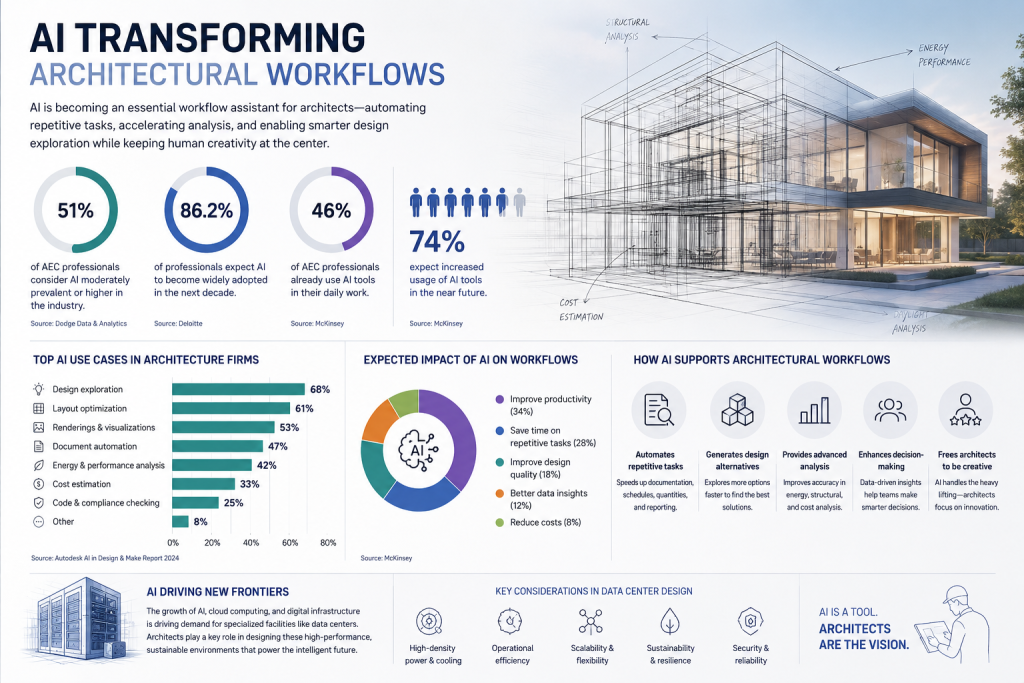
Artificial intelligence is one of the most influential architecture industry trends shaping 2026. AI is increasingly used as a workflow assistant that supports architects in tasks such as layout optimization, data analysis, and early-stage design exploration, rather than replacing human creativity.
In practice, AI helps automate repetitive tasks and speeds up processes like proposal writing, design variation generation, and project analysis. According to industry data, 51% of architecture and engineering professionals already consider AI moderately prevalent or higher in the industry, while 86.2% expect it to become widely adopted within the next decade. Another survey shows that 46% of professionals already use AI tools in their daily work, with 74% expecting increased usage.
AI is also influencing specialized areas such as data center design, driven by the rapid expansion of digital infrastructure and computing demands. As AI systems grow in complexity, architecture firms are increasingly involved in designing facilities that support this new technological ecosystem. While AI is powerful, its role remains supportive—freeing architects to focus on higher-level decision-making and creative problem-solving.
Building Information Modeling (BIM) and Digital Collaboration
Building Information Modeling (BIM) continues to be a foundational trend in modern architecture. BIM allows architects to create detailed, data-rich 3D models that improve accuracy, coordination, and communication across project teams.
Rather than functioning as a simple visualization tool, BIM has evolved into a collaborative digital platform that integrates geometry, materials, costs, and performance data. This enables architects, engineers, and contractors to work together in real time, reducing errors and improving project outcomes.
Adoption rates reflect its importance: 68% of AEC professionals have already integrated BIM into their workflows, and 65% of those users report that it delivers the highest return on investment for their firms. As BIM continues to improve collaboration and project delivery, it also supports stronger business development workflows, helping firms manage pipelines and generate consistent architect leads through more efficient project coordination and visibility.
Sustainability as the New Industry Baseline
Sustainability is no longer a trend in architecture, it has become the baseline expectation. Modern architecture now prioritizes energy efficiency, carbon reduction, and climate resilience. This includes designing buildings that minimize emissions throughout their entire lifecycle, from construction to operation and eventual reuse. Carbon-neutral strategies are becoming more common, supported by renewable energy systems, improved building performance, and sustainable material selection.
Climate change is a key force behind this shift. Architects are increasingly required to design buildings that not only reduce environmental impact but also withstand extreme weather conditions and long-term environmental stress. As a result, sustainability is embedded in both regulatory expectations and client demand, making it a defining feature of architecture industry trends in 2026.
Circular Economy: Adaptive Reuse and Material Reuse
Another major trend is the shift toward circular design principles, where buildings and materials are reused rather than discarded. Adaptive reuse is becoming a widely adopted strategy, transforming existing structures such as warehouses, factories, and historic buildings into new residential, commercial, or cultural spaces.
This approach reduces construction waste, preserves cultural heritage, and lowers the environmental impact of new development. Instead of demolishing buildings, architects are increasingly reworking existing structures to serve new purposes, extending their lifecycle and value.
Material reuse is also gaining importance. Reclaimed bricks, timber, stone, and other materials are being reintegrated into new designs, often with a focus on design for disassembly. This allows buildings to be adapted or deconstructed in the future without unnecessary waste, supporting a more sustainable and flexible built environment.
Modular Construction and Flexible Building Systems
Modular and prefabricated construction is another key architecture industry trend gaining momentum. This approach involves manufacturing building components in controlled environments before assembling them on-site.
The benefits include faster construction timelines, reduced waste, and improved cost efficiency. Because much of the work is completed off-site, modular construction is less affected by weather delays and on-site inefficiencies.
Beyond speed, modular design also introduces flexibility. Buildings can be expanded, modified, or reconfigured more easily than traditional structures. This adaptability is especially valuable in sectors such as housing, healthcare, and commercial development, where space requirements often change over time. Modular systems also align with broader sustainability goals by reducing material waste and improving resource efficiency.
Smart Buildings, Digital Twins, and IoT Integration
Smart buildings represent the growing integration of digital technology into the built environment. These buildings use sensors, automation systems, and IoT (Internet of Things) devices to monitor and optimize performance in real time.
Smart systems can adjust lighting, heating, ventilation, and security based on occupancy and environmental conditions. This improves energy efficiency, reduces operational costs, and enhances occupant comfort.
Digital twins take this concept further by creating virtual replicas of physical buildings. These models are continuously updated with real-time data, allowing architects and facility managers to monitor performance, identify issues, and optimize maintenance strategies throughout a building’s lifecycle.
Together, smart buildings and digital twins are transforming architecture into a data-driven discipline focused on long-term operational efficiency.
Material Innovation: Natural, Advanced, and Low-Carbon Materials
Material innovation is playing a central role in shaping architecture industry trends. Natural materials such as timber, clay, bamboo, and stone are increasingly used due to their lower environmental impact and strong performance characteristics.
Wood-based construction, including engineered materials like cross-laminated timber (CLT), is gaining attention for its strength, sustainability, and versatility. At the same time, recycled and reclaimed materials are becoming more common in both structural and interior applications.
On the advanced materials side, innovations such as self-healing concrete, smart glass, and carbon-reinforced composites are expanding what is possible in architectural design. These materials improve durability, energy efficiency, and adaptability, while also supporting more sustainable construction practices.
Low-carbon alternatives, including carbon-neutral cement, are also emerging as part of broader efforts to reduce emissions in the construction industry.
Human-Centered Design: Biophilic, Cultural, and Flexible Spaces
Human-centered design is a defining characteristic of modern architecture. One of its most prominent expressions is biophilic design, which integrates natural elements such as light, greenery, water, and organic materials into built environments. This approach is widely associated with improved well-being, productivity, and occupant satisfaction.
Cultural sensitivity is another growing focus, with architects increasingly designing buildings that reflect local traditions, history, and identity. This ensures that architecture is not only functional but also meaningful within its specific context.
At the same time, demand for multifunctional and flexible spaces is increasing. Buildings are now designed to adapt to changing needs, whether that means hybrid work environments, mixed-use developments, or adaptable residential layouts. Spaces are no longer static; they are expected to evolve alongside users’ lifestyles.
Community-centered design also plays a growing role, emphasizing inclusivity, accessibility, and social connection within architectural planning.
Conclusion
Architecture industry trends in 2026 reveal a discipline that is becoming more adaptive, data-driven, and sustainability-focused. Technology such as AI, BIM, and smart systems is transforming workflows, while sustainability and circular design principles are reshaping how buildings are planned and constructed.
At the same time, architecture is becoming more human-centered, with increased emphasis on well-being, cultural identity, and flexible use of space. The combination of digital innovation, environmental responsibility, and social awareness is defining the future direction of the industry.
As these trends continue to evolve, architecture is moving toward a model that is not only more efficient and intelligent, but also more resilient and responsive to both people and the planet.
Sources used:
- https://www.vectorworks.net/en-US/newsroom/future-architecture-trends
- https://www.iconic-awards.com/en/trends
- https://www.planradar.com/sg/construction-trends-in-architecture/
- https://www.planradar.com/au/smart-buildings-digital-construction-ecosystem/
- https://newschoolarch.edu/7-architectural-trends-every-student-should-know/
- https://openasset.com/resources/architecture-industry-trends/

Dimitar is a seasoned marketing specialist and the visionary behind CLICKVISION. With over 10 years in digital marketing, he excels in crafting marketing strategies that boost rankings, which in return increase leads, conversions, sales, profits, and ROI.